Two views of Collaborate: NCAC and the CACs of Arkansas
In the CAC world, the same software has to do two different jobs. At an individual center, it has to fit the actual workflow. Therapists, medical staff, advocates, and forensic interviewers all need to see the same client, even though they document very different things. At a statewide chapter, the same software has to roll dozens of independent member centers up into numbers that hold up to outside scrutiny.
We sat down with two long-time Collaborate users at opposite ends of that spectrum: Kelli Mukaddam at the National Children’s Advocacy Center in Huntsville, Alabama, and Dawn Meyer at the Children’s Advocacy Centers of Arkansas. The contrast in their answers maps almost perfectly onto the gap the software has to bridge.
NCAC: making one record work for everyone in the building
Kelli Mukaddam is the Data Specialist and Handle With Care Coordinator at NCAC, where she’s been a Collaborate user since 2018. NCAC is unusual among CACs in offering in-house medical and therapy services alongside the core forensic interview and advocacy work. Before Collaborate, that meant separate documents for separate disciplines.
“Our therapy team struggled to use our database because it wasn't a HIPAA-compliant database at that time. Our therapists were using one set of documents, our medical team was using another set of documents. Collaborate allowed us to bring everybody into one combined health record that worked for everybody.”

Kelli Mukaddam
Data Specialist / Handle With Care Coordinator, National Children’s Advocacy Center
The unified record changes day-to-day operations in ways that are easy to miss until you’ve worked without them. When an advocate is out for the day and a family calls, another staff member can pull up the notes and step in mid-case. The therapy team and the medical team aren’t reconciling two parallel files. They’re reading the same one.
Ease of use is the next thing Kelli flags when other CACs ask her about Collaborate.
“It's super easy to use. When I onboard new people, Collaborate is the least of my issues. I can build out reports to be exactly what I need to have all my grant data. I don't have to search through 5,000 reports or filter a million columns. And their support staff is amazing.”
Kelli Mukaddam
Data Specialist / Handle With Care Coordinator, National Children’s Advocacy Center
CACs of Arkansas: stats that match up across an entire state
Dawn Meyer’s job is fundamentally different from Kelli’s. She isn’t running cases. She’s coordinating data across every member CAC in Arkansas, where she’s been a Collaborate user since 2020.
Arkansas was a patchwork before Collaborate. Some centers were tracking work in spreadsheets. Others used different databases. All statistics flowed through a state governmental commission, and nothing was on a unified system. When the state chapter cited a number, and a senator’s office cited a number, and a member CAC cited a number, those three numbers usually didn’t match.
“It's professionalized our data collection and reporting so much. Previous to Collaborate, some of our centers were still using spreadsheets. No one was on a unified system. With Collaborate, we brought everybody together.”

Dawn Meyer
IT Operations Manager, Children’s Advocacy Centers of Arkansas
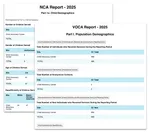
The custom statewide network report Network Ninja built for Arkansas is what makes the political conversation possible. The chapter, the centers, and the legislators are now reading off the same sheet. That sounds obvious. In a state where data was being collected six different ways before 2020, it wasn’t.
Arkansas is also structurally different from most states. Multidisciplinary Teams (MDTs), normally housed inside CACs, were set up under a separate government commission decades ago and only moved under the state chapter’s umbrella in 2021. The state is still working to align MDT and CAC data so a single child’s case can be tracked end-to-end. That’s nonstandard work, and it requires a software partner willing to do nonstandard work too.
“Y'all have been very responsive to our needs and willing to help think outside the box with me, which is really important because Arkansas is not set up like a lot of different states in child abuse response. Y'all are helping us bridge that gap of moving our state forward in being able to respond to child abuse in an effective way.”
Dawn Meyer
IT Operations Manager, Children’s Advocacy Centers of Arkansas
What the two views have in common
Two very different users. Both describe a vendor that bends to fit their work rather than the other way around. Kelli’s word was “personalized.” Dawn’s was “outside the box.”
The mechanism behind that, and the reason it matters for a nonprofit, is in something Dawn flagged: when a feature gets built for one organization, it gets made available to others. The same product accommodation that lets a single CAC bring its in-house medical and therapy services into one record is what later lets a state chapter get a custom statewide rollup that satisfies its government’s grant rules. Each accommodation widens the platform for everyone behind it. For nonprofits watching every dollar, that compounds.
Kelli put the user-side of it simply: “It can be personalized to whatever you need, makes your life so much easier, because then you just have exactly what you need at your fingertips.”
What Dawn didn’t expect was the cadence. Six years of steady improvement, and a willingness to take on edge cases that don’t look like anyone else’s.
For any CAC director or statewide coalition leader evaluating case management software, it’s a useful framing: ask not just whether the platform fits today, but whether the team behind it can keep adapting as your structure changes. Two long-time users picked the same answer, from opposite scales of the work.
Curious how Collaborate could fit your center or your statewide network? Contact us for a demo.